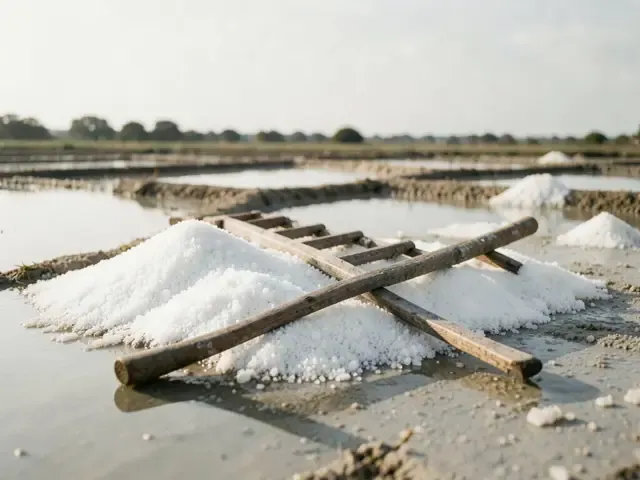
The North flats are the lowest ground in the valley, a mile of grey mud between the river mouth and the sea wall, and nothing grows there but samphire. For about four hundred years someone has been making salt on them. Anselm Rook is the latest, and he has six pans, a wooden rake, and a pair of rubber boots that he says are older than I am.
Making sea salt is mostly waiting. In April Anselm lets the spring tides fill a reservoir, and the sun slowly takes the water down. By the end of June it has concentrated into a brine you can taste from the other side of the pan. He then moves it by gravity into the six shallow pans, each about the size of a double bed, and the real work begins. He needs a week without rain. One shower and he has to start the pan again.
The week
This year the dry week ran from the 24th to the 30th of July. On a good day a skin of fine crystals forms on the surface of the brine at about eleven in the morning, and by two it is thick enough to rake. The flakes are very thin and hollow, almost like small pyramids, and they break between your fingers. They are lifted with a flat wooden rake and a scoop, drained on a rack at the edge of the pan, and spread out on a clean table in the sun.
A pan gives about nine kilos on a good afternoon, and Anselm rakes each pan once a day. He leaves the bottom layer, which is greyer and coarser, to make the next batch. We took 41 kilos in the end, which was enough for the year’s smoked salt and a little extra for our own kitchen.
Smoking it
Salt doesn’t need smoke. We do it because the flakes soak up flavour more quickly than anything else we make. Tom builds a small fire of oak offcuts from a local cooper in the back of the old dairy, and the salt sits on racks above it in a closed chamber for two days. It is cold smoke, so the fire never gets hot enough to melt the crystals, only to colour them. The flakes come out the colour of weak tea and smell like a campfire after the rain.
It is not a table salt. Use it at the end, on things that are already cooked: a baked potato, an egg, grilled aubergine, a thick slice of tomato. A pinch of it on dark chocolate is very good. Don’t cook with it, because the smoke goes in the steam.
A few notes
Keep the tin dry and the lid closed. The salt draws water out of the air and will clump on a humid day, which is fine: break it up with your fingers. And if it ever turns very damp, spread it out on a baking sheet and put it in a low oven for ten minutes.
The flats are open to walk on, and Anselm doesn’t mind visitors if they don’t step in the pans. Wear boots.