We pick when the first olives on the lower terraces turn from green to the colour of a bruise, and not a day later. This year that was Monday 12 October. The rule is simple and hard to keep: from the moment a branch is stripped, the fruit has six hours to reach the press. After that it starts to ferment in the crates, and you can taste it in the oil for the whole year.
Four days of picking
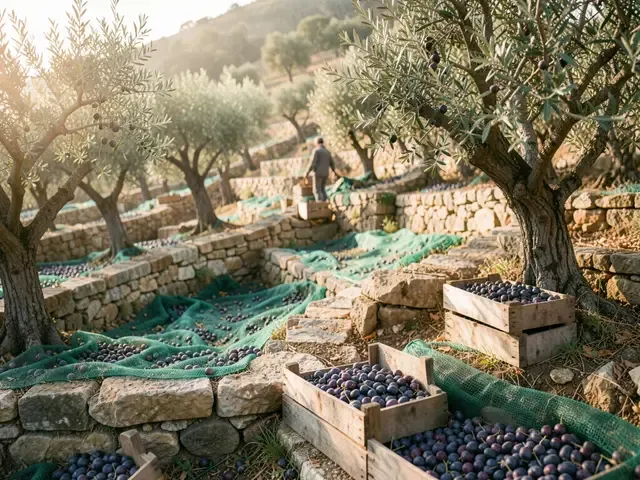
Eleven people picked this year, four more than last. Marta brought her sister and two cousins from the upper terraces, Pell came down from the hives on his one free afternoon, and a few friends from Hollin turned up on the Saturday and stayed until it got dark. We lay nets under each tree, strip the branches by hand with small plastic rakes, and tip the fruit into shallow crates. Shallow matters. Olives piled deep in a crate heat up from the middle.
A good picker does about forty kilos an hour. By Thursday evening we had a little over six tonnes from the terraces, which is a thin year for us but a clean one. There was a late frost in spring and the trees skipped a flowering, so there were fewer olives, but every one that came off was firm and unmarked.
Six hours
On the Wednesday, the 14th, the first crates went onto the trailer by ten and were at the co-op mill by half past. Jory had the press warm and the machine washed. He keeps a rule of his own: nobody’s olives are mixed with ours until ours are done, so the first run of the day is always a single grower’s oil. Ours came off the press at about two in the afternoon, which is four hours from the tree, well inside the limit.
Cold-pressed means the paste never goes above 27 degrees. At the mill the olives are crushed to a paste, stirred slowly for twenty minutes in a closed tank, and then spun in a centrifuge to separate the oil from the water and the solids. Nothing is added and nothing is heated. What comes out is cloudy and bright green and smells like cut grass, and it is the best thing you will taste all year.
We stood at the spout with a piece of bread each and dipped it in the stream, which is how every pressing at the mill has started for as long as anyone remembers. The oil is peppery at the back of the throat, so much that Tom coughed. That means it is good.
The mill runs all night
Once the single-grower runs are done, the mill belongs to the whole valley. Neighbours bring their olives all week and Jory keeps the press going until the last trailer has been emptied, usually around three in the morning. That oil is blended and becomes our everyday oil, pressed on 2 November this year when the last of the late fruit came in.
We let the oil settle in steel tanks for three weeks, racked off the sediment once, and bottled the first of it at the end of the month. It is better in January than it is in November, and better in November than it was at the spout, because the sharpness softens and the green gets rounder. If you want the loudest version, buy it now and use it on warm beans. If you want something calmer, wait.
The 250 ml and 500 ml bottles are in the shop. The 3 litre tin is sold out until next year.