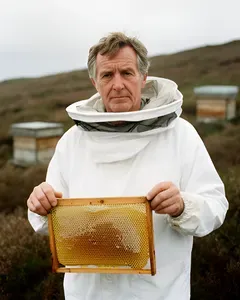
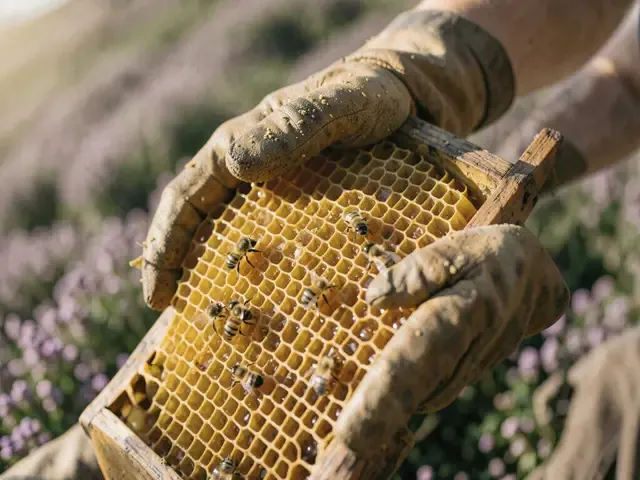
A frame is ready when the bees have capped most of its cells with wax. Capped honey is ripe. Uncapped honey is still wet, and if you take it, it will ferment in the jar a month later. So the first job on any honey day is not to take anything. It is to look.
I keep forty hives, thirty-one of them on the heather ridge and nine between the lower terraces and the lanes. The terrace hives give the pale spring honey you know as wildflower. The ridge gives the autumn honey, which is dark and thick because it comes almost entirely from heather, and heather honey behaves differently from every other kind. It is a gel. If you stir it, it turns to liquid, and if you leave it, it sets again to something like jelly. You can’t spin it the way you spin clover honey.
The day
I start at seven, before the bees are in the air. Smoke first, from a tin smoker burning dry sacking, a few puffs at the entrance and a few under the lid. Then I lift out the frames one at a time and hold them up to the light. A good frame is heavy, and when you tilt it nothing moves. A bad one drips.
The ripe frames go into a closed box and the bees get brushed off with a goose feather. I leave at least two full frames in every hive and more in the ones on the exposed side of the ridge. Taking too much is how you lose a colony in February.
Back in the shed I cut the wax cappings off with a warm knife, a long serrated one I keep in a jug of hot water, and drop them into a tray. The cappings drain overnight and the honey from them is the best of the lot. Then the frames go into the extractor, which is a drum with a hand crank. For ordinary honey, ten minutes of cranking pulls it out of the comb. Heather honey won’t leave the cells that way, so I press it. The frame goes into a press, and the honey comes out as a thick amber paste with air bubbles in it.
Settling and jarring
Everything goes through a single cloth into a bucket, where it stands for two days. The bubbles rise and I skim them off. Then it is jarred, by hand, with a ladle. Nothing is heated, so nothing is lost. Honey heated above 40 degrees loses much of the scent that makes it taste of the place.
This year I took 214 kilos from the ridge on 20 September, which is about the same as last year. The autumn honey is dark, thick, a little bitter at the end, with a taste something between toffee and smoke. Some people don’t like it and ask for the pale one. I understand.
A tip if you buy a jar: don’t put it in the fridge. Cold makes honey set hard. If yours has gone solid, stand the jar in a bowl of warm water, not hot, for twenty minutes. It will come back.